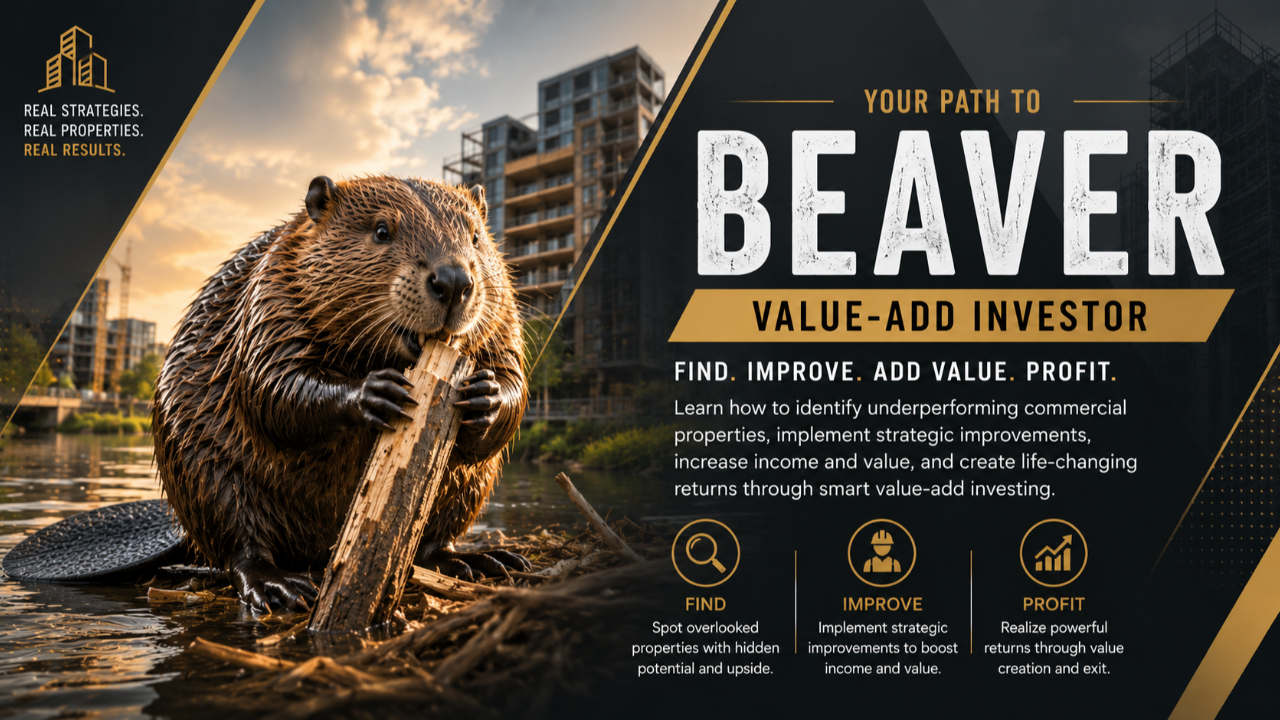
You're a Beaver: Value-Add Investor
Commercial Real Estate Investor
Your fastest path to cash may be hiding inside a property that isn't performing as well as it could.
If your Commercial Real Estate Investor Strategy Quiz brought you here, your strongest starting strategy is the Beaver — Value-Add Investor.
You're interested in more than simply finding a commercial property.
You want to find potential.
A property with income that could be improved. Expenses that could be managed better. Vacancies that could be filled. Operations that could be strengthened. Repairs or improvements that could change what the property produces—and ultimately what it's worth.
That's the heart of value-add commercial real estate investing.
And you don't have to master every commercial real estate strategy before you begin learning how to recognize those opportunities.
Your Beaver Roadmap shows you what to learn first, what to focus on next, when to begin looking at real properties, and what you can leave for later.
Why Value-Add Investing May Be Your Fastest Path to Cash
A Beaver looks at a commercial property a little differently.
Someone else might see what the property is.
You naturally start wondering what it could be.
Maybe rents are below market.
Maybe occupancy is poor.
Maybe expenses are unnecessarily high.
Maybe management needs improvement.
Maybe the physical property needs work.
Maybe tenant spaces need improvement.
Maybe the property is simply being operated in a way that leaves money—and therefore value—on the table.
Your job isn't merely to find a cheap building.
It's to learn how to recognize a commercial property where intelligent changes could create additional value.
That's why your roadmap begins with the numbers.
Your Beaver Advantage: See What Could Be Better
Beavers build.
That's your advantage.
But in commercial real estate, value-add investing isn't simply about swinging a hammer.
Sometimes the greatest improvement isn't physical at all.
It may come from improving occupancy.
Increasing appropriate rents.
Reducing unnecessary expenses.
Improving management.
Changing the tenant mix.
Renegotiating contracts.
Making strategic repairs or tenant improvements.
Repositioning the property.
Or making other changes that increase Net Operating Income — NOI.
Because in commercial real estate, improving NOI can do something much bigger than simply improve this month's cash flow.
It can increase the value of the property itself.
That's why a Beaver needs to understand both sides of the equation:
What can I improve?
and
What will that improvement do to the numbers?
Step 1: Learn the Numbers Before You Try to Improve Them
Your Beaver path begins with the commercial real estate fundamentals.
Inside The Confident Commercial Real Estate Investor Course, you'll start by learning how commercial properties are evaluated, including the ratios and economics behind a purchase.
You'll learn to understand:
- Income
- Expenses
- NOI
- Cash flow
- Important commercial real estate ratios
- Deal economics
- Deal structure
You'll also begin working with tools such as the Property Data Collection Form and Doc's Online Commercial Real Estate Calculator.
Before you can identify an underperforming property, you have to understand what healthy—or potentially healthy—performance looks like.
You aren't learning numbers simply to pass a lesson.
You're learning them so you can recognize opportunity.
Step 2: Learn How Commercial Real Estate Value Is Created
Now we get into the heart of your Beaver strategy.
The complete program contains specific training devoted to maximizing commercial real estate value.
You'll learn about strategies involving:
- Maximizing NOI
- Improving and optimizing property performance
- Tenant improvements
- Remodeling
- Repairs
- Increasing cash flow
- Repositioning property
- Refinancing
- Potential exit strategies
This is where you begin looking beyond the asking price.
A Beaver learns to ask:
What is keeping this property from performing better?
Can I realistically change it?
What will it cost?
What could happen to the income if I succeed?
And what could that do to the property's value?
That's a very different way of looking at commercial real estate.
Step 3: Learn Due Diligence and Build the Right Team
Seeing potential is one thing.
Determining whether that potential is realistic is another.
Before pursuing a value-add opportunity seriously, you need to understand what you're actually buying.
Your Beaver roadmap therefore moves into the parts of the program covering due diligence and the professionals who may help you evaluate and execute the plan.
Depending on the property, that may include:
- Property managers
- Contractors
- Commercial mortgage brokers
- Accountants and other professional advisors
- Brokers
- Inspectors and other specialists
You aren't expected to personally perform every repair, manage every tenant, arrange every loan and analyze every legal or tax issue.
You need to understand enough to assemble and work with the people who can help you execute the strategy.
Step 4: Start Looking for Real Value-Add Opportunities
You don't need to finish the entire Commercial Real Estate Mentorship Program before you start looking at properties.
Once you understand the core numbers, the basic economics of commercial property, the fundamentals of creating value, and the role of your professional team, you can begin evaluating actual opportunities.
That may mean:
- Choosing a commercial property type
- Choosing a market to investigate
- Screening listings
- Looking for off-market properties
- Gathering property information
- Reviewing income and expenses
- Looking at occupancy
- Comparing rents
- Identifying operational problems
- Estimating needed repairs or improvements
- Asking where NOI could realistically be improved
- Running preliminary numbers
At this point, you aren't necessarily ready to buy.
You're ready to start recognizing which properties deserve a deeper look.
That's a big difference.
Step 5: Study the Property Type When You Find the Opportunity
Here's another place where your personalized roadmap can save you an enormous amount of time.
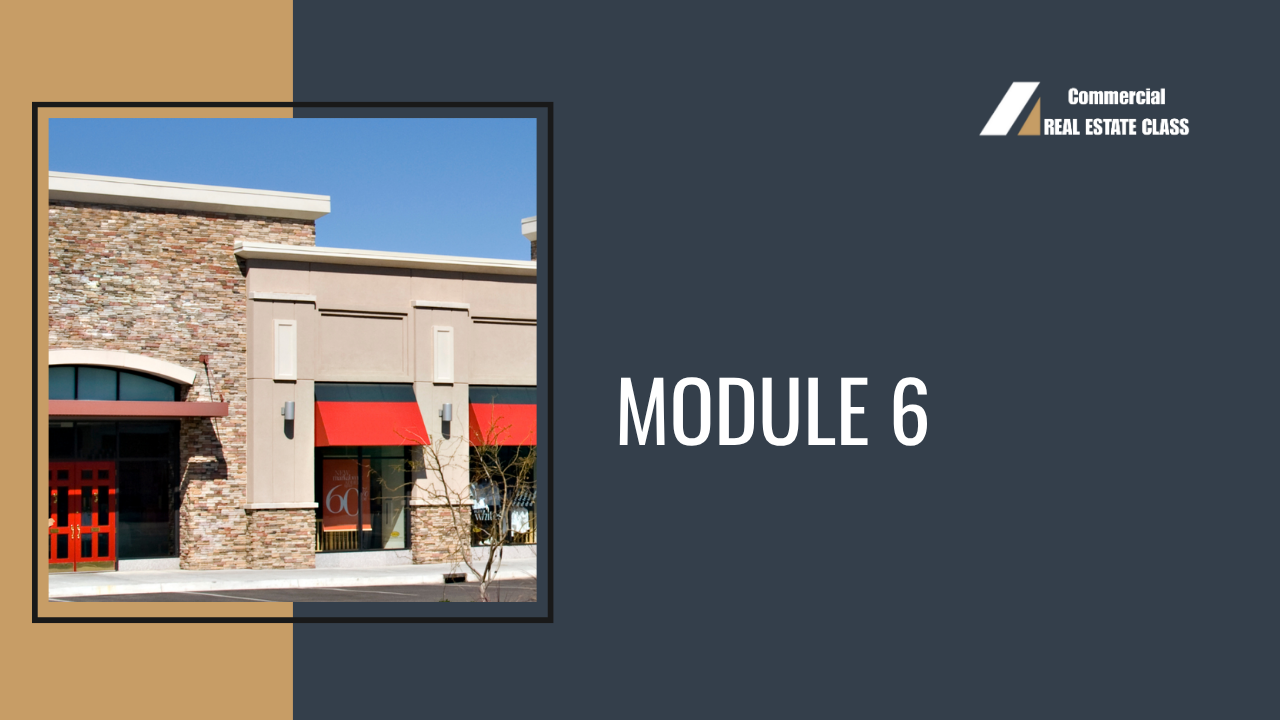
You don't need to master apartments, self-storage, mobile home parks, office buildings, industrial properties, strip shopping centers and every other commercial property type before you begin.
Choose a direction.
Start looking.
Then use the extensive property-specific training inside the complete program when it becomes relevant to an opportunity you're actually considering.
Looking at apartments?
Study the apartment material.
Found an interesting self-storage facility?
Go deeper into self-storage.
Looking at a mobile home park?
Now that training matters.
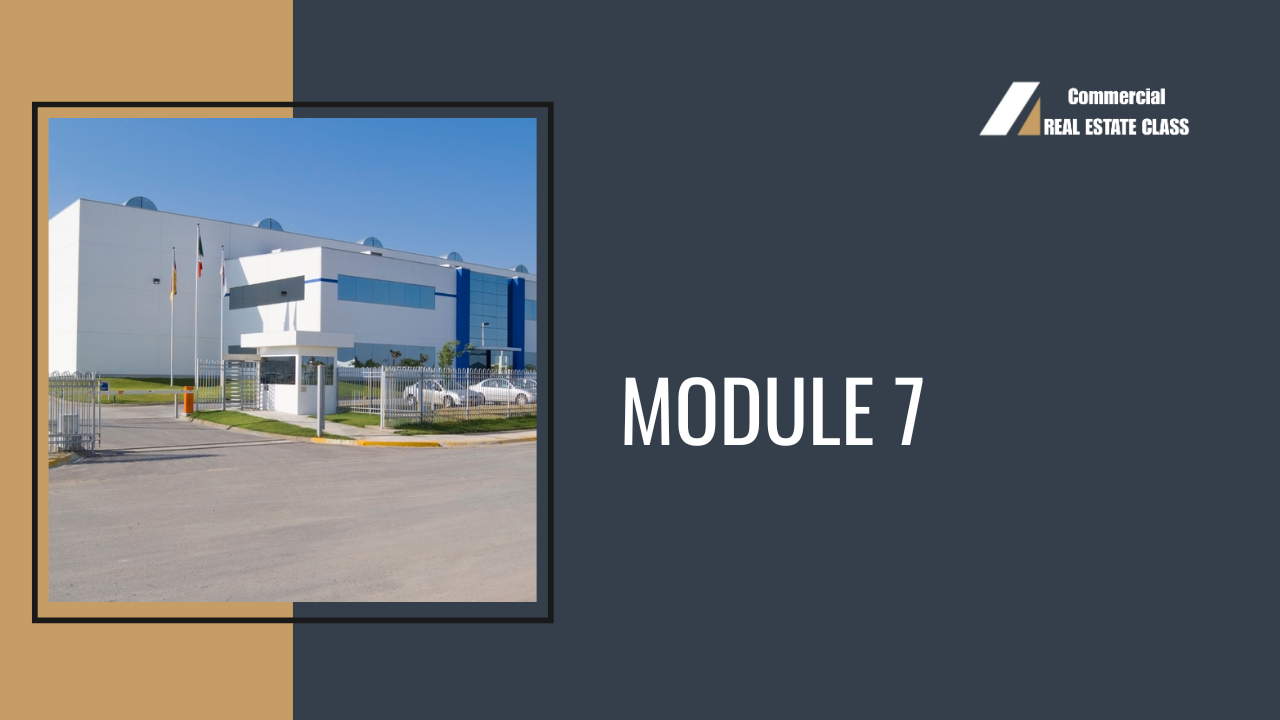
Considering industrial?
That's when you study industrial properties.
Learn what you need when you have a reason to need it.
Step 6: Go Deeper When a Deal Earns Your Attention
A property can look exciting without being a good investment.
That's why the next stage comes only when a real opportunity deserves it.
When you identify a serious candidate, that's when you go deeper into the program's training on:
- Financing
- Contracts
- Due diligence
- Negotiation
- Closing
- Entity setup
- Property management
- Contractors
- Deal-specific analysis
Your value-add idea has to survive the numbers.
The financing has to work.
The improvements have to be realistic.
The potential increase in income has to justify the cost and risk.
Potential isn't enough.
The deal has to make sense.
Your Strategy Can Change as You Grow
Being a Beaver doesn't mean every property you improve has to be sold.
That's important.
You might buy a property because you see an opportunity to improve its income, operations, occupancy or physical condition.
You execute the plan.
NOI improves.
The property becomes more valuable.
And then you look at what you've created and think:
Why would I sell this?
Maybe you refinance.
Maybe you keep the property.
Maybe it becomes part of the portfolio you're building for the long term.
Congratulations.
Your Beaver strategy has just begun moving toward the Eagle — Wealth Builder strategy.
Or perhaps you uncover a tremendous opportunity that you don't want to acquire yourself.
Your Cheetah — Transaction Facilitator education is already inside the program too.
You aren't buying a Beaver course.
You're getting the complete commercial real estate program and using your personalized Beaver Roadmap to determine where to begin.
Real Student. Real Motivation.
This is where I would use your Texas contractor.
His story fits Beaver beautifully because he'd already spent years doing the work that helped other property owners create value.
He understood construction.
He understood improvements.
He knew how properties could be changed.
But eventually he wanted something different:
He wanted to understand how to use that knowledge to create opportunity for himself.
That's why he came to Doc's commercial real estate program.
And after going through the training, his takeaway was essentially:
Now I know how to do it.
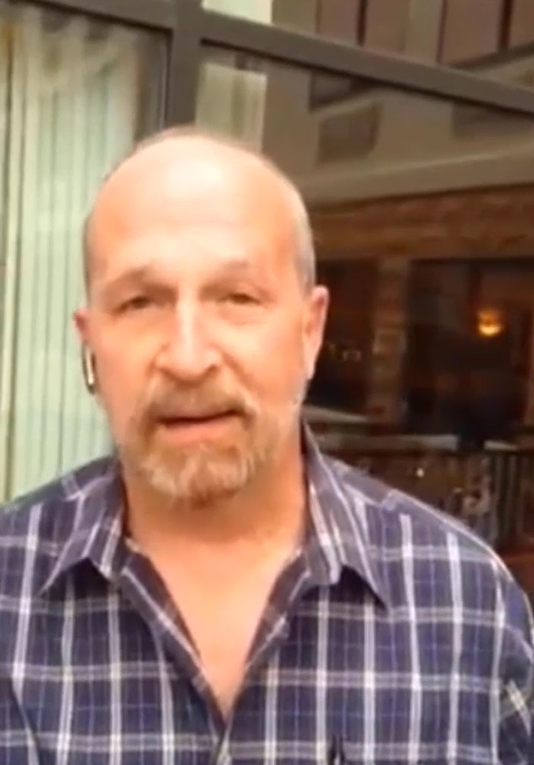
GENERAL CONTRACTOR
Doc’s Commercial Real Estate Student
“I enjoyed every moment of it. I was greatly enlightened. I didn’t know what to anticipate coming in, and I was literally inundated with information—with all kinds of tactics and different ways to make money in the real estate world.
I’m a general contractor by trade. I realized that I needed to start making money on both ends of this.
Doc has not only enlightened me as to how I can do it, but he’s given me a clear path to get it done.
I would suggest anyone—anyone that has a chance to visit with Doc—certainly do it. It’s worth anything you’ve got to pay to get here.”
You Don't Need to Master Everything Before You Start
The Confident Commercial Real Estate Investor Course is comprehensive.
You get the complete program.
But your Beaver Roadmap gives you a much simpler way to begin:
Learn the Numbers → Learn How Value Is Created → Understand Due Diligence & Your Team → Start Looking → Study the Property Type → Go Deeper When a Deal Earns It
That's your path.
You're not trying to learn everything today.
You're learning how to recognize what could be better—and whether improving it could create a worthwhile commercial real estate opportunity.
Ready to Follow Your Beaver Roadmap?
Want a copy of your personalized roadmap so you can come back to it?
Enter your name and email below and we'll send your Beaver Value-Add Investor Roadmap directly to your inbox.
You'll have a simple reference showing:
- What to learn first
- Where to focus next
- When to begin looking at real properties
- What you can leave for later
- How to go deeper when you find an opportunity
- How your strategy can evolve as your experience grows
Your Fastest Path Doesn't Have to Be Your Final Destination
Commercial real estate gives you options.
You can facilitate transactions.
You can create value.
You can own income-producing assets.
And over the course of your investing career, you may do all three.
Right now, your quiz results suggest that your strongest place to begin is by learning to recognize unrealized potential, understand what could improve the property's performance, and determine whether creating that value makes financial sense.
That's your Beaver path.
Now you know where to start.